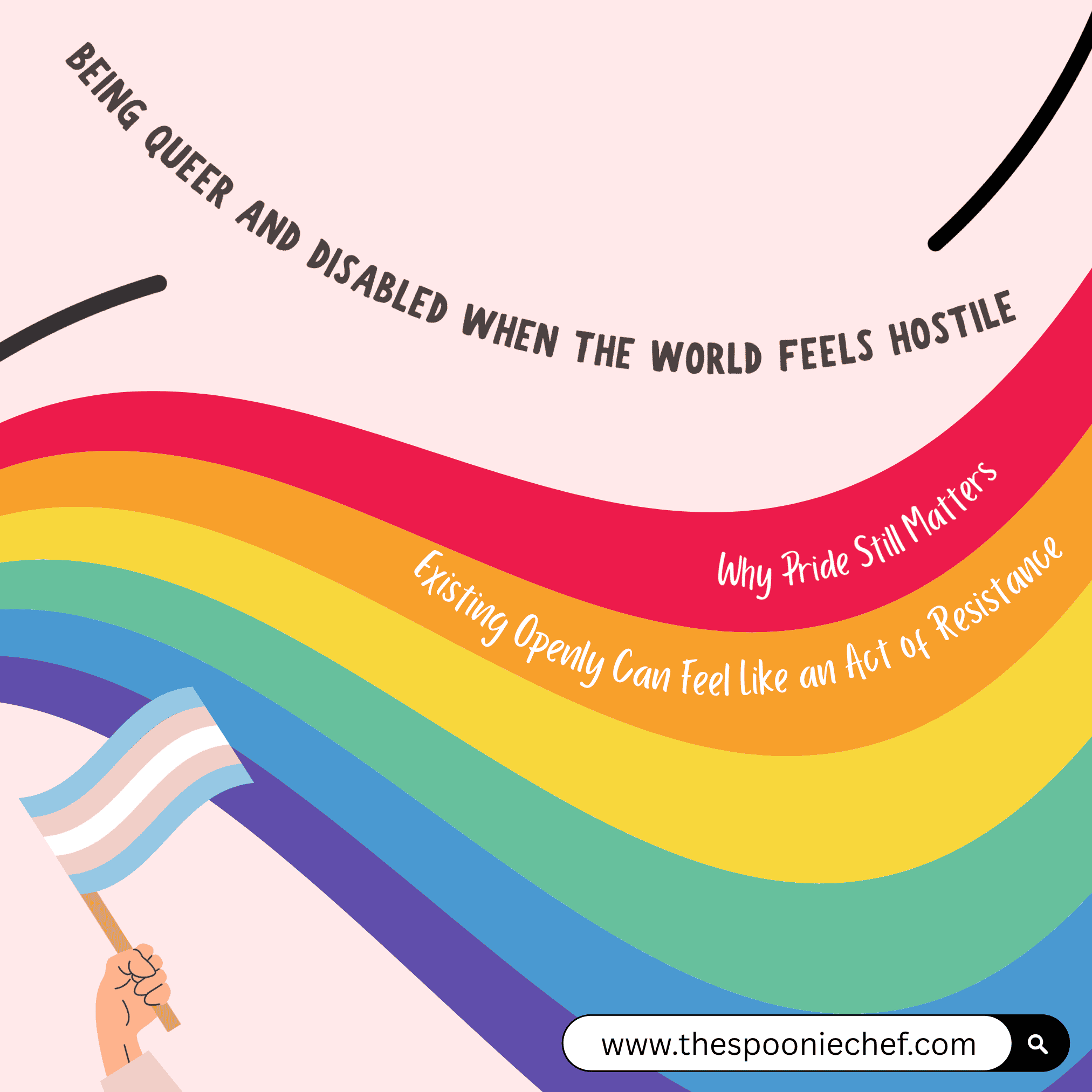
Being Queer and Disabled When the World Feels Hostile

Last Updated on 12 November 2026 by Karolyn
Pride Month is often presented as a celebration. Rainbows and parades filled with joy and community.
And while all of those things matter, I think it would be dishonest to pretend that’s the whole story. This year, Pride feels heavier.
While we’re being encouraged to celebrate, many of us are also watching our rights, our safety, and our dignity become topics of public debate.
As a queer disabled person, that reality feels impossible to ignore.

Pride Started as a Protest
Sometimes I think we’ve become so used to seeing rainbow logos every June that we’ve forgotten why Pride exists in the first place.
Pride didn’t begin as a celebration. It began because queer people were tired of being treated as less than human.
It began because people stood up and said enough. The celebrations and joy came later.
The reason Pride still matters is because the fight that created it has never fully ended.
Watching My Trans Siblings Come Under Attack
One of the hardest things about being queer right now is watching the way trans people are being spoken about.
Trans people are not a threat, they are not a debate, they are not a political talking point. They are our friends, partners, siblings, children, neighbours, and community members. Yet increasingly, I see conversations that treat trans people’s existence as something that needs to be questioned, scrutinised, or even justified.
I see people discussing basic human rights as though they’re hypothetical thought experiments.
I see trans people asked to defend their existence over and over again and I think many of us are exhausted. Standing up for trans people shouldn’t be controversial; It should be the easiest thing in the world.
When one part of our community is under attack, all of us have a responsibility to speak up. Trans rights are human rights, always.
Being Queer and Disabled in the UK Right Now
Growing up, I think many of us believed things would continue getting better. That progress would move forwards and that each generation after mine would have more freedom than the last.
Lately, that confidence feels harder to hold onto. Across multiple equality measures and international rankings, the UK’s position has slipped significantly in recent years.
Conversations and debates that once felt settled now feel uncertain again. And rights that seemed secure suddenly feel extremely fragile and that’s frightening.
Not because progress is impossible but because it reminds us that progress is never guaranteed.
Disabled People Are Facing Their Own Wave of Hostility
At the same time, disabled people are increasingly being portrayed as burdens.
We’re often discussed in terms of costs, benefits, productivity, or economic impact.
Rarely as people or as neighbours, friends, partners, parents, creators, workers, and human beings.
The language used around disability can be incredibly dehumanising. You start seeing headlines that suggest your worth is tied to how much you can produce.
How much you can work, How little support you need, How only certain people should be eligible for benefits.
As someone living with chronic illness, I know how quickly those messages can get under your skin. You begin feeling as though your existence needs to be justified and I am tired of having to justify mine.
Existing Openly Can Feel Like an Act of Resistance
There are days when being visible feels easy and there are days when it feels terrifying. Sharing my life online means allowing people to see parts of me that some would rather didn’t exist.
I’m openly queer and I’m openly disabled. Neither of those identities should be controversial to be open about. Yet both can attract criticism, assumptions, judgement, or hostility. Some days it feels as though simply existing in public is enough to make someone uncomfortable.
Sometimes visibility feels empowering, sometimes it feels exhausting. Most of the time it’s a mixture of both.
Why Pride Matters for Queer and Disabled People
This is exactly why Pride still matters. It’s not because life is perfect. Or not because equality has been achieved. Not because rainbows fix everything.
- Pride matters because people deserve to exist without apology.
- It matters because visibility saves lives.
- Pride matters because community reminds us we aren’t alone, because isolation is exactly what prejudice wants.
- It matters because there are young queer people watching, trying to figure out whether they have a future too.
- Pride matters because there are disabled queer people wondering if there’s a place for them.
- Pride matters because some people would rather we disappeared quietly.
And we’re still here. We’ve always been here. And we will always be here.
To My Fellow Queer and Disabled Humans
If this year feels complicated, you’re not alone. Or if you’re tired, you’re not alone. And if you’re frightened about the direction things seem to be moving, you’re not alone.
So, if your version of Pride this year is simply existing, resting, surviving, and refusing to disappear, that counts too. Maybe now more than ever. Because visibility isn’t always loud. Sometimes it’s simply choosing to remain here when the world would rather you were invisible.
Queer joy is important, but so is queer resilience. And sometimes simply continuing to be visible is an act of courage. I see you, my beautiful friends.
Keep in Touch
If this post resonated with you, I’d love to hear your thoughts in the comments below.
You can also follow along on Instagram for more conversations about chronic illness, disability, food, travel, and life as a spoonie, or join my newsletter for future posts from the Spoonie Life & Stories series.